

 100% Confidential

Get Help Today 24/7
Get Help Today 24/7
Tempe Addiction Treatment & Mental Health Resources Guide

Dr. Rostislav Ignatov, MD
Chief Medical Officer
Tempe continues to face a serious addiction crisis, with overdose rates among the highest in Arizona. In 2023, the city recorded 90 overdose deaths and more than 400 non-fatal overdoses, with Tempe North ranking fourth statewide for overdose incidents.
Even amid these challenges, Tempe has built a strong response system. First responders reversed 129 overdoses with naloxone in 2023, and opioid settlement funding is expanding treatment programs, crisis services, and recovery support across the city.
Today, residents can connect with medical detox, residential and outpatient treatment, peer recovery networks, mobile crisis teams, supportive housing, and bilingual services. For those seeking professional, evidence-based treatment, The Haven Detox – Arizona offers trusted addiction and mental health care serving patients across Tempe, and the surrounding communities.
This guide highlights the full range of addiction and mental health resources available in Tempe, helping individuals and families find the right pathway to care.
If you or someone you love is struggling, get professional addiction and mental health care near you. Our admissions team can explain detox, residential treatment, and mental health care options.
Available Now
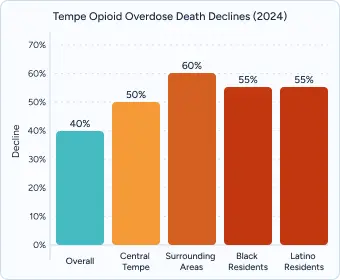
Tempe recorded a notable reduction in opioid overdose deaths in 2024
Seeing an overall decline of 35%—the city’s lowest rate since 2016 and a sharp turnaround from the 2023 increase. Central Tempe neighborhoods experienced a 42% decrease, while surrounding areas saw a 29% decline. The progress was especially significant among marginalized groups: Black residents reported a 50% drop and Latino residents a 37% drop in overdose deaths compared to the previous year. These results follow a period in 2023 where Tempe saw a 14% rise in opioid fatalities, even as other regions in Arizona registered declines.
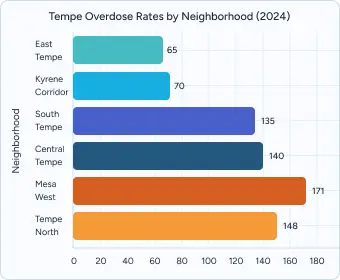
Significant Neighborhood Gaps Persist in Tempe’s Overdose Rates
Stark differences continue to shape Tempe’s overdose crisis in 2024. Tempe North experienced an elevated rate of 148 overdoses per area, while neighboring Mesa West reached 171 per area. Central Tempe, the university district, and south Tempe also reported high overdose rates, with central neighborhoods showing a marked rise from 2022 to 2023. In contrast, north Tempe residential zones, the Kyrene Corridor, and east Tempe maintained much lower overdose numbers, emphasizing persistent geographic disparities across the city.
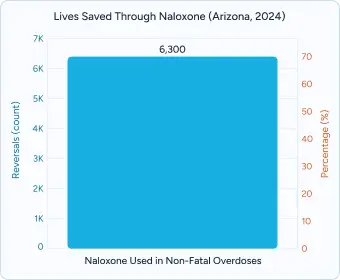
Lives Saved Through Naloxone (Arizona, 2024)
State data show the lifesaving impact of naloxone in overdose response. In 2024, more than 6,300 overdose reversals were reported by community partners across Arizona, with naloxone administered in 70% of suspected non-fatal overdoses.
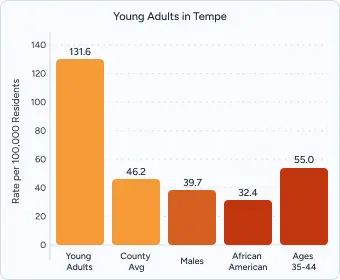
Young Adults in Tempe face an unprecedented opioid overdose emergency.
Nearly half (131.6 per 100,000) of young adults in Tempe North experience non-fatal overdoses, compared with the county rate of 46.2 per 100,000. With higher rates among males (39.7 per 100,000), Black/African Americans (32.4 per 100,000), and individuals aged 35–44 (55.0 per 100,000). More concerning, less than half receive support through CARE 7 crisis services.
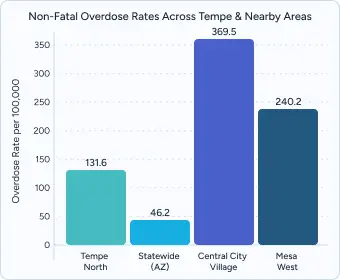
Demographic disparities compound treatment challenges across Tempe neighborhoods.
Nearly half (131.6 per 100,000) of residents in Tempe North report non-fatal overdoses, up from the statewide rate of 46.2 per 100,000 in 2022. Rates are especially high in Central City Village (369.5 per 100,000) and Mesa West (240.2 per 100,000). Yet many in these areas lack adequate harm reduction and peer-support resources.

CARE 7 serves as a centralized access point for treatment information and referrals. The program includes 24-hour crisis intervention and mobile response teams, distributing over 1,000 naloxone kits in 2024. The Tempe Coalition Harm Reduction program expands on this safety net by delivering mobile outreach across the city, offering naloxone distribution, safe syringe disposal, and peer-led education to reduce overdose risk and connect residents with treatment resources.
Transportation accessibility through Valley Metro links all neighborhoods to Tempe drug rehab programs and mental health facilities. The Light Rail provides direct access to the ASU/downtown corridor, while Routes 40, 48, and 72 connect outlying areas such as Ahwatukee and Chandler. The Dial-a-Ride service offers specialized transportation for individuals with disabilities, ensuring that care remains accessible citywide.
AHCCCS covers 100% of treatment costs for eligible Arizona residents, including medical detox, residential rehab, outpatient therapy, and approved medications such as methadone and buprenorphine. As of 2025, AHCCCS has removed all copayments for substance use and mental health care, with coverage now reaching residents up to 138% of the federal poverty level.
AHCCCS Complete Care ensures broad access to care for both children and adults. This coverage includes crisis services and ongoing support, with applications available through the Health‑e‑Arizona Plus online portal or by calling 1-855-432-7587. Enrollment materials and assistance are provided in both English and Spanish.
Arizona Complete Health and Mercy Care offer additional financial help for residents not eligible for Medicaid, covering individuals up to 138% of the federal poverty level. Applications can be completed online or at AHCCCS regional offices, with multi-language support.
Tempe Counseling Services assists uninsured residents by providing wraparound funding and help finding available treatment options. To learn about public treatment slots and support resources, visit the Tempe Counseling Services website or call 480-350-5400.
Private facilities eliminate wait times through free insurance verification, comprehensive assessment protocols, and Tempe medical detox availability. Evidence-based therapies include EMDR, family systems therapy, and mindfulness-based Tempe relapse prevention approaches.
Insurance processing typically occurs within 48 hours with same-day admission capabilities when clinically appropriate for individuals ready to begin treatment.
The Haven Detox – Arizona offers immediate access to evidence-based addiction and mental health treatment serving the Tempe area. The facility combines traditional therapies like CBT and DBT with holistic approaches including Reiki, art therapy, and yoga, plus cutting-edge GeneSight genetic testing to personalize medication selection. With one of the highest staff-to-client ratios in Arizona, the Tempe location provides both medical detox and residential treatment in a comfortable, resort-like environment.
Learn more about programs and admissions by calling the 24/7 helpline for personalized guidance.
Central Arizona’s comprehensive Tempe mental health services include depression treatment, anxiety care, and dual-diagnosis support across University area, downtown Tempe, and south Tempe neighborhoods. Programs feature culturally competent care, bilingual Spanish-English providers, and trauma-informed approaches through facilities like Lifeline PCS and Prisma Community Care.
Neighborhood-specific mental health resources ensure accessibility across Tempe’s diverse communities. University area programs include ASU Counseling Services and student-focused therapy providing mobile crisis units serving college-aged populations with specialized academic support. South Tempe services include faith-based counseling through various churches and peer-led support circles focused on families and working professionals.
Rising Spirit Group in Tempe (2041 E University Dr) provides free peer-led recovery support, specialized support groups for trauma survivors, and sober social events with weekend programming.
Tempe Bloopers Center (1859 E Baseline Rd) offers daily AA meetings, LGBTQ+-affirming groups, and bilingual Spanish-English programming with easy Light Rail access.
New Spirit Group in Tempe (3840 S Rural Rd) delivers peer coaching, family support services, and culturally responsive groups tailored to Latino communities and college students.
Transitional Homes in Tempe provide structured sober living with AzRHA certification standards. Arizona Recovery Housing Association maintains the statewide directory of certified homes meeting NARR quality standards.
Riviera Men’s Oxford House holds AzRHA certification. Provides 24-hour peer support, keyless entry systems, Wi‑Fi access, shared kitchen facilities, and on-site parking with equal expense sharing among residents.
Arizona Sober Living Network maintains NARR accreditation. Offers structured programming including weekly house meetings, chore rotation systems, and regular sobriety verification with curfew policies and community service requirements.
Recovery Meetings Citywide coordinate through Salt River Intergroup serving the greater Phoenix area. Salt River Intergroup at saltriverintergroup.org coordinates over 200 weekly meetings with partnerships through the Meeting Guide app providing real-time updates.
Spanish-Language Meetings serve Latino communities throughout Tempe and surrounding areas with multiple daily options and specialized women’s and men’s groups through bilingual programming.
LGBTQ+ Recovery Meetings provide affirming support at Lambda Phoenix Center’s bilingual programs, with culturally responsive programming, including transgender-specific meetings and specialized support groups.
Comprehensive assessment should address both substance use and mental health needs, since co-occurring issues like depression, anxiety, and trauma are common for many seeking addiction treatment in Tempe.
Evidence-based therapies are essential for successful outcomes. Leading programs offer proven methods such as Acceptance and Commitment Therapy (ACT), Eye Movement Desensitization and Reprocessing (EMDR), and Contingency Management, supported by long-term recovery research.
Culturally responsive care is vital in Tempe’s diverse community. Look for providers who offer Spanish-language services, LGBTQ+-affirming specialized groups, and faith-based or culturally matched support to address the unique backgrounds and identities of clients.
Aftercare Coordination connects clients with outpatient therapy programs, peer-led recovery groups like AA/NA, and transitional sober housing through warm handoffs and ongoing community partnerships with local treatment providers.
Family Engagement and Support includes multi-family therapy sessions and educational workshops for relatives, with Spanish-language groups and culturally tailored programming for Latino families throughout Tempe.
Comprehensive Programming integrates multiple therapeutic modalities with community support.
Trauma-Informed Care utilizes neurofeedback therapy and somatic experiencing approaches with staff receiving specialized EMDR certification and ongoing trauma treatment training.
Alumni Support Networks provide quarterly reunion events and digital peer forums connecting graduates through mentorship programs and ongoing recovery community engagement.
Benefits Navigation and Support Services include financial advocates and referral coordinators helping clients access housing assistance, vocational training, and sliding-scale consultation services for continued care.
Professional treatment represents an investment in recovery success, offering immediate access, personalized care, and comprehensive services designed to address the complex nature of addiction and mental health conditions.
Take the Next Step Today by calling for immediate support and assessment.
Insurance Verification Services complete coverage reviews within 24–48 hours providing detailed cost estimates and pre-authorization assistance ensuring transparency in treatment planning and financial obligations.
Assessment and Intake Coordination offers same-day comprehensive evaluations with next-day treatment placement options featuring streamlined processes that minimize administrative delays while supporting treatment readiness and motivation.
Most AHCCCS-contracted programs schedule initial assessments within 48 hours, then connect you with a therapist based on availability and specialization needs.
AHCCCS and Mercy Care typically cover individual and group therapy with zero copays; private insurance varies by plan and provider network participation.
Yes. Multiple community centers offer bilingual AA/NA meetings and specialized Latino recovery groups with Spanish-speaking facilitators throughout Tempe.
Tempe Counseling Services provides sliding-scale fees based on income, and several nonprofit clinics offer grant-funded treatment for uninsured residents.
Valley Metro offers reduced-fare programs, and some treatment facilities provide ride vouchers or partner with medical transportation services for clients.
CARE 7 operates 24/7 crisis response at 480-350-8004, while EMPACT-SPC provides around-the-clock mental health and substance abuse emergency support.
Yes. CARE 7 offers family consultation services, and Al-Anon provides support groups for relatives affected by someone else’s substance use.
Programs include Spanish-language recovery groups, LGBTQ+-affirming services at Lambda Phoenix Center, and faith-based support through various religious organizations.
ASU provides campus-based counseling, while programs like ASAP (Adolescent Substance Abuse Program) offer intensive outpatient services specifically designed for young people.
Let’s talk about what’s going on — no judgment. (We’ve been there before ourselves). No one will know you inquired and there is no commitment to call.
24/7 Support
No Commitment
100% Private

Why Wait?
Get Answers Now
You’re here because you know you need help. Let’s talk through it together. There’s no commitment and it’s 100% confidential even to check your insurance.
100% Confidential
