100% Confidential



It’s not always clear when normal stress or mood changes turn into something that needs real support.
A good way to look at it is this: if changes in mood, behavior, or thinking are lasting more than a couple of weeks, getting worse, or starting to affect daily life, it’s usually a sign that something more is going on.
Most people don’t notice one single symptom. They notice a combination of things that start to feel different from how the person normally is.
Emotional Changes
Behavioral Changes
Cognitive Changes
Changes in Daily Functioning
If several of these are happening at the same time, or if things have been getting worse instead of better, it’s usually a sign that extra support could help.
Bringing this up is often the hardest part.
Even when you’re calm and coming from a place of concern, the conversation can quickly turn defensive or shut down completely. That doesn’t mean you approached it wrong—it usually means the person isn’t ready to see the situation the same way you do.
It helps to go into the conversation with a clear goal. The goal is not to convince them or force a decision. It’s to open the door and make it easier for them to consider getting support.
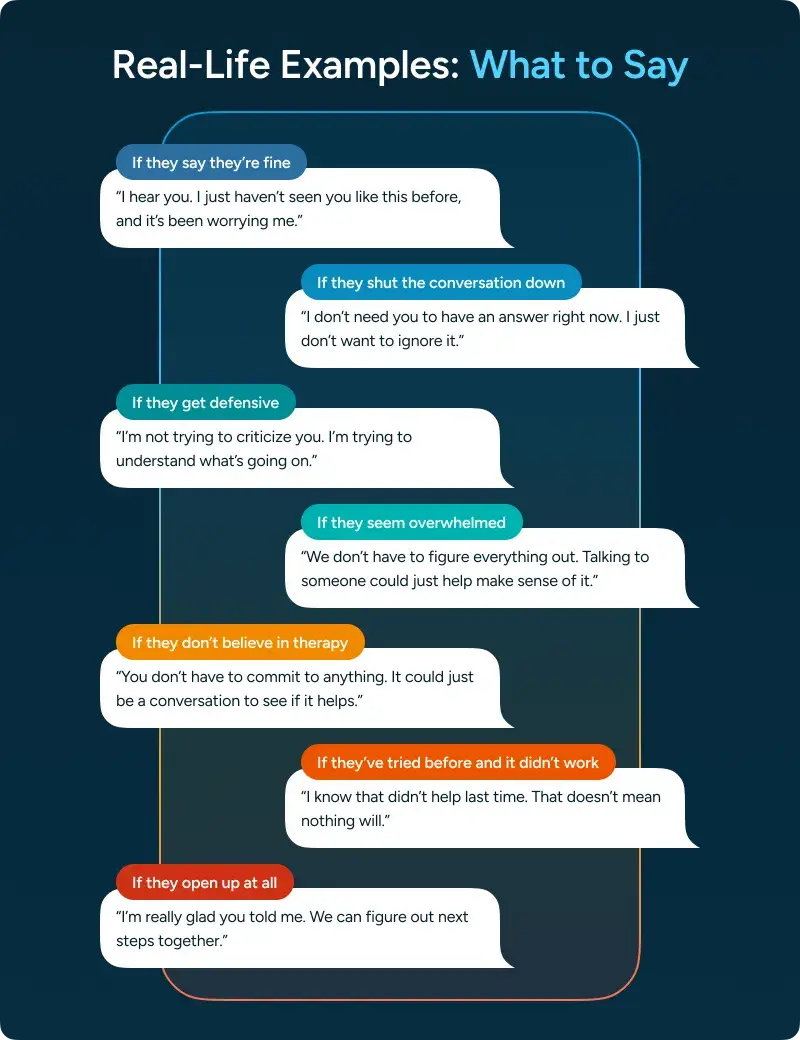
Focus on specific changes you’ve noticed rather than general statements.
Instead of saying:
Keep it grounded in what you’ve seen:
This keeps the conversation from feeling like an accusation.
If the conversation feels emotional or confrontational, it’s more likely to shut down.
Try to:
You don’t need to say everything at once. A shorter, clear conversation is usually more effective than trying to cover everything in one moment.
People are more likely to engage when the next step feels manageable.
Instead of focusing on treatment, focus on starting with a conversation:
This lowers resistance and keeps the focus on understanding, not committing.
Timing makes a difference.
Conversations tend to go better when:
Trying to have this conversation during a high-stress moment usually leads to defensiveness.
It’s common for this to take more than one attempt.
Someone may not be ready the first time you bring it up. That doesn’t mean the conversation didn’t matter. It often takes time for people to process what they’re hearing and come back to it later.
Staying consistent, calm, and clear over time is usually more effective than trying to resolve everything in one discussion.
If they refuse to engage or change the subject, it’s usually best not to push harder at that moment.
You can step back and revisit it later while keeping the message consistent. The goal is to keep the conversation possible, not force it to happen all at once.
This is often the point where people start to feel stuck, especially if they’ve had multiple conversations that haven’t led anywhere. The next step is understanding what to do when they continue to refuse help.
It’s common for this to take more than one conversation.
You may have already brought it up several times and gotten the same response—denial, avoidance, or frustration. At that point, it can start to feel like nothing is going to change, no matter what you say.
That’s usually where people feel the most stuck.
What’s important to understand is that doing nothing doesn’t keep things the same. In most cases, symptoms either continue or gradually get worse over time.
Even if you’re frustrated, pushing harder or trying to force the issue usually leads to more resistance.
It helps to stay clear and consistent:
You don’t need to prove anything. You’re making it clear that you see what’s happening and that it matters.
General statements are easier to dismiss. Specific examples are harder to ignore.
Instead of repeating:
Focus on:
This keeps the conversation grounded and harder to deflect.
This is where the conversation often needs to shift.
Without being threatening, it’s important to acknowledge reality:
If things continue the way they are, the impact usually spreads—to work, relationships, health, and daily functioning.
Saying this clearly can help move the conversation forward, especially if previous conversations have stayed too surface-level.
One conversation rarely changes everything.
People often need time to process, especially if they feel overwhelmed or defensive. Bringing it up again, calmly and consistently, can make a difference over time.
The goal is not to “win” one conversation. It’s to keep the door open.
The easier the next step feels, the more likely they are to consider it.
That might mean:
Small steps are easier to agree to than major decisions.
There are situations where this goes beyond concern and becomes a safety issue.
This may include:
In these cases, outside intervention may be necessary.
Each state has laws that allow for evaluation when someone may be a danger to themselves or others or unable to care for themselves. The specifics vary, but the goal is the same: to get immediate support when safety is at risk.
Supporting someone does not mean accepting everything.
In some situations, it may be necessary to set clear limits around what you can and cannot continue to support—especially if their behavior is affecting your safety, your household, or others.
Boundaries are not punishment. They are a way to protect stability while still encouraging change.
This is often the hardest part.
You can support, encourage, and make help available but you cannot force someone to accept it unless safety becomes a concern.
That doesn’t mean you stop trying. It means focusing on what you can control: how you communicate, how you respond, and when to involve additional support.
If you’re unsure what to do next, talking to a professional can help you understand your options.
You don’t need to wait for the situation to become a crisis to get guidance. An assessment can provide clarity on what level of support may be appropriate and how to move forward.
There are times when this situation shifts from concern to something more immediate.
If someone is at risk of harming themselves, harming others, or is no longer able to care for themselves, it’s important to act right away.
If you believe there is an immediate risk:
In the United States, you can call or text 988 to reach the Suicide & Crisis Lifeline, or call 911 if the situation is urgent.
If possible, go to the nearest emergency room.
If someone is refusing help but their safety is at risk, an involuntary mental health evaluation may be required.
Most states have laws that allow this under specific conditions.
Common State Laws for Involuntary Mental Health Evaluation
While the names and processes vary, the criteria are generally similar. This step is considered when someone is:
In these situations, law enforcement, medical professionals, or designated officials can initiate an evaluation to determine what level of care is needed. This is not about punishment. It is a safety measure used when someone cannot make that decision on their own.
It’s better to take action and be wrong than to wait and have things escalate.
You don’t need to be certain to reach out for help.
If you’re in this position, you don’t have to keep trying to figure it out on your own.
When conversations haven’t gone anywhere and things are starting to feel more serious, it helps to talk to someone who understands how these situations typically unfold and what options are available.
A quick conversation can help you understand:
You don’t need to wait for things to escalate further to get that clarity.
Calling The Haven Detox Group is a practical first step. You can speak with someone who will walk through what’s happening, answer your questions, and help you decide what to do next.