Trends in Substance Treatment
America’s substance use epidemic is evolving—but the nation’s help-seeking behavior isn’t keeping up.
A new study from The Haven Detox uses exclusive internal data along with national drug use data to reveal that hallucinogens, alcohol, and cannabis—some of the most widely used substances in the U.S.—are also among those least likely to drive people to seek help.
The study analyzes 2022–2023 data from the National Survey on Drug Use and Health and Haven’s own treatment records to provide previously unseen data on which substances have the greatest disparity between use and treatment.
Rather than access to care, this data reflects how cultural perception and substance effects influence help-seeking behavior. Substances like opioids are more likely to trigger intervention because of overdose risk and withdrawal. But substances like hallucinogens—while increasingly used—often don’t prompt users to seek treatment, even when harmful effects occur.
“The data doesn’t just show who’s using what—it shows who thinks they need help. That’s a different story entirely,” says Dr. Rostislav Ignatov MD, Chief Medical Officer at Haven Health Management. – Dr. Rostislav Ignatov MD, Chief Medical Officer at Haven Health Management
Key Findings From The Study
- People who use hallucinogens are the least likely to seek help than other drugs, with only 1 out of 23 people seeking treatment (7.1 million users vs. 139.7 million treated → 1:23 treatment ratio).
- Alcohol sees only 1 out of every 19 people seeking treatment (139.7 million users vs. 7.1 million treated → 1:19 use-to-treatment ratio).
- Only 1 out of 16 cannabis users seek treatment (61.9 million users vs. 3.7 million treated → 1:16 use-to-treatment ratio).
While substances like hallucinogens, alcohol, and cannabis often don’t prompt people to seek treatment, professional help is available regardless of which substance you’re struggling with. Our addiction treatment programs provide medically supervised detox and inpatient rehabilitation for all substance use disorders. For those with co-occurring mental health conditions, we offer integrated dual diagnosis treatment. Treatment is available in Arizona, Arkansas, Florida, Massachusetts, New Jersey, and Puerto Rico. Check your insurance coverage or review our insurance information. Contact our admissions team to begin treatment, regardless of which substance has become problematic.
Hallucinogens Have The Largest Disconnect Between Use and Treatment
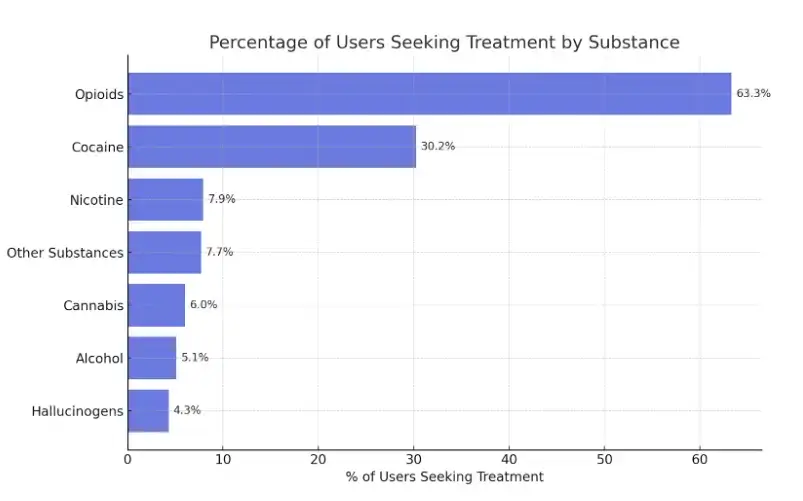
Hallucinogens like psilocybin, LSD, and DMT now show the widest gap between use and help-seeking behavior. The data reveals 7.4 million annual users and only 320,000 treatment cases—a 1:23 ratio, in other words, 1 user seeking treatment for every 23 people using hallucinogens, the highest of any substance in the study.
Unlike opioids or alcohol, hallucinogens don’t cause physical dependency or withdrawal. Yet because these substances are often perceived as “mind-expanding” or “spiritually enlightening,” very few view their experiences as needing professional support.
“Hallucinogens are culturally framed as tools for healing and exploration. That framing may be silencing the need for help when things go wrong” – Dr. Rostislav Ignatov MD, Chief Medical Officer at Haven Health Management

Opioids: High risk, High Engagement
Opioids are one of the only substances in the study where treatment-seeking behavior keeps pace with use. With 5.1 million annual users and 3.2 million receiving treatment, the roughly 2:1 ratio indicates a far narrower disconnect compared to all other drugs analyzed. The existence of widespread, structured treatment programs—such as those involving methadone, buprenorphine, and naloxone—makes treatment more accessible and normalized.
Alcohol: Widely Used, but Widely Untreated
Alcohol remains the most consumed substance in the country—with nearly 140 million past-month users. Yet only 7.1 million people sought treatment, yielding a 1:19 use-to-treatment ratio. That makes it the second most untreated substance by volume.
Because alcohol is embedded in American culture—from celebrations to stress relief—it can take years of misuse before someone considers seeking help.
Cannabis: Perception Outpaces Reality
Cannabis use has skyrocketed alongside legalization and shifting public opinion. According to the study, 61.9 million Americans used cannabis in the past year, but only 3.7 million received treatment, creating a 1:16 treatment ratio.
High frequency cannabis use has been linked to increased risk of anxiety, depression, motivation, and cognitive impairment.
“As cannabis use becomes more accepted, people are slower to admit when it starts negatively affecting their work, relationships, or mental health” – Dr. Rostislav Ignatov MD, Chief Medical Officer at Haven Health Management
Cocaine, Nicotine, and Other Illicit Drugs Show Moderate Disconnects
Cocaine, nicotine, and other illicit drugs fall into a middle tier—used widely enough to pose concern, but not often enough to drive consistent help-seeking behavior. Cocaine had 5.7 million users and 1.7 million treatment cases, yielding a 1:3 treatment ratio. While lower than alcohol or cannabis, the data suggests that many users delay seeking help until use escalates or becomes publicly visible.
Nicotine and other illicit substances show similar patterns. With 47.4 million nicotine users and 3.8 million in treatment, the 1:13 treatment ratio reflects a longstanding cultural normalization—particularly with the rise of vaping. Other illicit drugs, including meth and synthetic substances, have roughly a 1:13 ratio, shaped by regional stigma and inconsistent treatment access.
Cocaine, nicotine, and other illicit drugs fall into a middle tier—used widely enough to pose concern, but not often enough to drive consistent help-seeking behavior. Cocaine had 5.7 million users and 1.7 million treatment cases, yielding a 1:3 treatment ratio. While lower than alcohol or cannabis, the data suggests that many users delay seeking help until use escalates or becomes publicly visible.
Nicotine and other illicit substances show similar patterns. With 47.4 million nicotine users and 3.8 million in treatment, the 1:13 treatment ratio reflects a longstanding cultural normalization—particularly with the rise of vaping. In fact, young adults (ages 21–24) now account for the most prevalent vaping rates according to drug statistics, with 15.5% in 2023, highlighting how nicotine use has shifted toward younger generations. Other illicit drugs, including meth and synthetic substances, have roughly a 1:13 ratio, shaped by regional stigma and inconsistent treatment access.
“These aren’t the most ignored substances—but they’re often treated too late. People recognize the risks, but wait for things to get worse before acting” – Dr. Rostislav Ignatov MD, Chief Medical Officer at Haven Health Management


 100% Confidential