Get Help Today 24/7
Using Third-Party Administrator Insurance for Substance Abuse and Mental Health Treatment
If your health insurance is managed by a third-party administrator (TPA), understanding coverage for substance abuse and mental health treatment can feel confusing, even when benefits are available.
Many employer-sponsored plans don’t work like traditional insurance policies. Instead of a carrier like Blue Cross or Aetna making coverage decisions, benefits are administered by a third party on behalf of the employer. These plans are often employer-funded, customized, and less transparent than fully insured plans.
For people seeking inpatient rehab or detox, this structure can lead to mixed messages about coverage, authorization requirements, or whether treatment is considered “in-network” at all. This page explains how third-party administrator insurance for substance abuse and mental health treatment works, what typically causes confusion, and how to approach coverage verification if your plan is administered by a TPA.
A third-party administrator is a company hired to manage health benefits for an employer. TPAs typically handle:
Unlike traditional insurance carriers, TPAs do not insure members or assume financial risk. In many cases, the employer pays healthcare claims directly, while the administrator manages the logistics of the plan.
Because employers design their own benefits, coverage details can vary widely, even when the same administrator is used.
Role
What They Control
Employer
Third-party administrator (TPA)
Treatment provider
Patient
What services are covered and how much they pay
Claims, authorizations, and benefit administration
Clinical care and documentation
Deductibles, coinsurance, and following plan rules
Role
Employer
What They Control
What services are covered and how much they pay
Role
Third-party administrator (TPA)
What They Control
Claims, authorizations, and benefit administration
Role
Treatment provider
What They Control
Clinical care and documentation
Role
Patient
What They Control
Deductibles, coinsurance, and following plan rules

Coverage for substance abuse and behavioral health treatment under a TPA-administered plan is determined by employer plan design, not a standardized insurance policy.
In practice, this means:
One of the most common challenges with TPA plans is that benefit details are not always clearly documented or easily accessible. As a result, people may be told different things by different providers or offices. This doesn’t automatically mean treatment isn’t covered, it usually means the plan needs to be verified carefully.
While every employer plan is different, the administrators below tend to follow similar patterns when it comes to authorization, access to inpatient care, and out-of-pocket cost.
UMR administers employer-sponsored health plans and is affiliated with UnitedHealthcare. While UMR often uses UnitedHealthcare provider networks, UMR-administered plans are not the same as UnitedHealthcare insurance policies.
What commonly affects substance abuse and mental health coverage under UMR-administered plans:
Because coverage rules are set at the employer level, two UMR plans can function very differently.
Meritain Health, an Aetna company, administers benefits for employer-sponsored health plans, many of which are self-funded or level-funded.
Common characteristics that impact addiction and behavioral health treatment:
A frequent source of confusion is assuming all Aetna facilities are automatically covered, which isn’t always the case with Meritain-administered plans.
Lucent Health administers benefits for employer-sponsored plans, often on a regional basis, and is known for highly customized benefit structures.
With Lucent-administered plans, substance abuse and mental health coverage may involve:
Because Lucent plans vary significantly between employers, benefits verification is especially important before admission.
Auxiant commonly administers employer-sponsored and self-funded health plans. One of the most common experiences among Auxiant members is being told their plan is “self-pay,” which is often a misunderstanding.
What typically influences rehab coverage under Auxiant-administered plans:
Self-funded does not mean uninsured, but it does mean coverage details must be confirmed directly.
Imagine360 administers benefits specifically for self-funded employers and operates with a care navigation and advocacy model.
Key factors that affect substance abuse and mental health treatment under Imagine360 plans:
Because Imagine360 emphasizes cost management and care coordination, authorization often happens earlier in the process than with other administrators.
Third-party administrator plans tend to feel harder to navigate than traditional insurance because:
These differences are also why out-of-pocket costs can vary so much between plans — even when the same administrator is involved.
With TPA-administered insurance, three things usually determine what someone may pay for inpatient rehab:
Cost Term
What It Means
Deductible
Coinsurance
Out-of-pocket maximum
Authorization
What you pay first before insurance starts helping with costs
How the cost is split between you and insurance after the deductible
The most you’ll pay in a year for covered care
Approval for how many days of treatment insurance will help cover
Cost Term
Deductible
What It Means
What you pay first before insurance starts helping with costs
Cost Term
Coinsurance
What It Means
How the cost is split between you and insurance after the deductible
Cost Term
Out-of-pocket maximum
What It Means
The most you’ll pay in a year for covered care
Cost Term
Authorization
What It Means
Approval for how many days of treatment insurance will help cover
A deductible is the amount you must pay each year before insurance starts helping with costs.
With many employer-sponsored TPA plans:
After the deductible is met, most TPA plans split the cost between you and the insurance plan. This is called coinsurance.
Common coinsurance arrangements include:
Most employer-sponsored plans have an out-of-pocket maximum, which is the most you’re expected to pay in a year for covered care.
With TPA-administered plans:
Authorization has a big impact on how much inpatient rehab ends up costing. Most TPA-administered plans:
Example:If 14 inpatient days are approved and additional days are not, those extra days may not be covered — even if you’ve already met your deductible.
This is one of the most common reasons people see unexpected costs.
Even when the same third-party administrator is involved, costs can vary because:
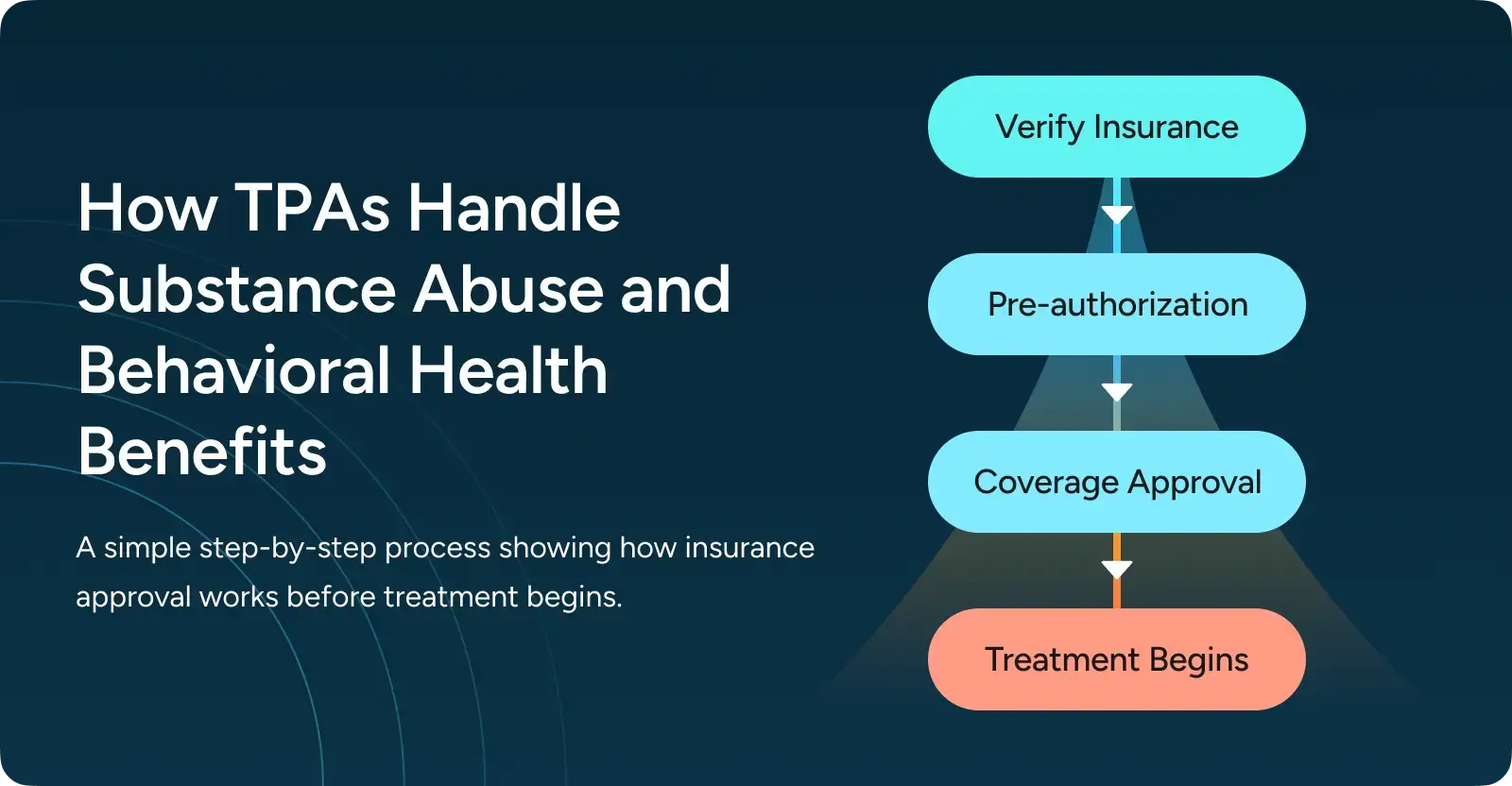
If your insurance is administered by a third party, the most important step is verifying benefits before admission.
Helpful questions to ask include:
Clear answers usually require working with someone familiar with how TPA-administered plans function.

Third-party administrators such as UMR, Meritain Health, Lucent Health, Auxiant, and Imagine360 often manage benefits for employer-sponsored plans that include inpatient substance use treatment, and in some cases, inpatient mental health care.
Because coverage, network participation, and authorization requirements depend on how an employer’s plan is structured, verification is always required. The following inpatient rehab locations are commonly verified with TPA-administered plans, depending on benefit design and authorization criteria.
TPAs don’t provide coverage themselves, but many employer-sponsored plans they administer include inpatient substance abuse and mental health treatment when medical necessity criteria are met.
No. Self-funded means the employer pays healthcare claims directly. Self-pay means no insurance coverage exists.
Because each employer designs its own benefits, even when the same third-party administrator is used.
In most cases, yes — especially for inpatient or residential levels of care.
Your information will be kept private
Let’s talk about what’s going on — no judgment. (We’ve been there before ourselves). No one will know you inquired and there is no commitment to call.
Need someone to talk to? We’re always here—day or night.
Ask questions, get guidance—no pressure, no obligation.
Your story stays with us. Confidential support, always.
Why Wait?
Get Answers Now
You’re here because you know you need help. Let’s talk through it together. There’s no commitment and it’s 100% confidential even to check your insurance.
100% Confidential
Why Wait?
Get Answers Now
You’re here because you know you need help. Let’s talk through it together. There’s no commitment and it’s 100% confidential even to check your insurance.
100% Confidential