

 100% Confidential
Newark Addiction Treatment & Mental Health Resources Guide
Dr. Rostislav Ignatov, MD
Chief Medical Officer
Newark carries one of the highest behavioral health needs in New Jersey. In 2023, residents of Newark alone accounted for 4,609 substance-use treatment admissions—nearly 60% of all admissions in Essex County. Local data also show that heroin and opioids remain the most common primary drugs of concern, followed by alcohol, cocaine, and cannabis. These figures reflect the scale of need within the city and the urgency of strengthening local systems of support.
Alongside statewide crisis and Medicaid programs, Newark residents can access a wide range of community-based services. These include peer recovery networks, youth development programs, family education initiatives, crisis hotlines, mobile response teams, and sober living options. Such resources provide direct, neighborhood-level support that helps residents navigate challenges, stabilize in times of crisis, and sustain long-term recovery.
This guide brings together Newark-specific data and resources, highlighting how residents can connect with community supports, statewide services, and recovery networks like The Haven Detox – New Jersey are designed to meet urgent and ongoing behavioral health needs.
If you or someone you love is struggling, get professional addiction and mental health care near you. Our admissions team can explain detox, residential treatment, and mental health care options.
Available Now
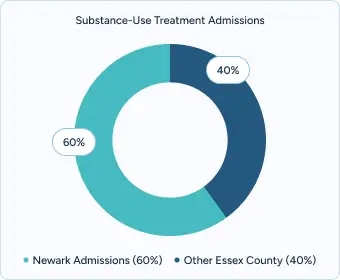
Newark Leads Essex County in Substance-Use Treatment Admissions (2023)
Local admissions: In 2023, Newark residents recorded 4,609 substance-use treatment admissions, representing nearly 60% of all admissions in Essex County. This makes Newark the single largest driver of treatment demand in the region.
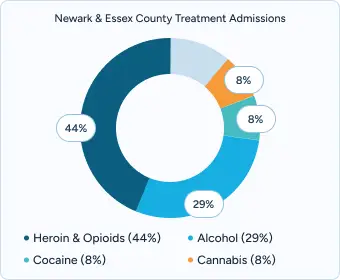
Substance Trends in Newark & Essex County: Opioids, Alcohol, and Other Drugs
Substance trends: Among Newark and Essex County residents admitted to care, the leading substances were heroin and opioids (44%), followed by alcohol (29%), cocaine (8%), and cannabis (8%). These patterns reflect ongoing concerns about opioid use while also highlighting alcohol’s major role in treatment admissions.
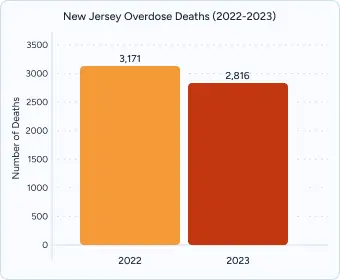
Statewide Overdose Deaths in New Jersey: First Decline in a Decade (2023)
Statewide context: New Jersey saw 2,816 overdose deaths in 2023, a decline from 3,171 in 2022. This marked the first decrease across all racial and ethnic groups in roughly a decade, though overdose rates remain high compared to national averages.

Rising Emotional Distress: 42% of NJ High School Students Report Sadness or Hopelessness
High rates of persistent sadness/hopelessness: A Rutgers/New Jersey State Policy Lab review reports ≈42% of NJ high-school students endorsed feeling sad or hopeless most days; similar distress appears in middle-school data, signaling broad need for school-connected support.

Mental Health Burden Among NJ Children: Anxiety & Depression on the Rise
Growing burden among NJ children: Recent Kids Count analyses indicate 10.7% of New Jersey children (≈168,000) were reported to have anxiety and/or depression in 2020, up from 7.6% in 2016, reflecting a marked increase over time.
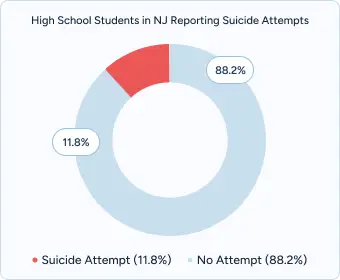
Suicide Attempts Among NJ High School Students: Findings from the 2021 Student Health Survey
In the 2021 New Jersey Student Health Survey, approximately 11.8% of high school students statewide reported having made a suicide attempt in the past 12 months.

Newark is served by a growing network of statewide and local behavioral health programs that facilitate access to addiction treatment in Essex County and mental health care. New Jersey has recently launched 988 Mobile Crisis Outreach Response Teams (MCORTs), now operational statewide, to respond to non-life-threatening mental health, substance use, and suicidal crises. These teams are connected to the 988 Lifeline system and offer in-person outreach when needed. ⓘ
In Essex County, Children’s Mobile Response & Stabilization Services (CMRSS) provides on-site crisis response for children and youth up to age 21, particularly for those in foster care or with developmental/behavioral challenges. These services are intended to intervene prior to inpatient or more restrictive placements.
The New Jersey Medicaid program, NJ FamilyCare, provides comprehensive coverage for behavioral health and addiction treatment for Newark residents. Benefits include crisis intervention, outpatient counseling, residential services, inpatient psychiatric care, substance use disorder treatment, and medication-assisted treatment (MAT) such as buprenorphine, methadone, and naltrexone. Coverage also extends to supportive services like peer and family programs, case management, interpreter assistance, and transportation when medically necessary.
New Jersey maintains policy standards for timely access to care for Medicaid members to ensure that urgent needs are addressed quickly:
The NJ FamilyCare online provider directory confirms which providers are in-network, accepting new patients, and offering specialized services such as bilingual counseling or culturally tailored care.
The Haven Detox – New Jersey, located in Blackwood, NJ, provides well-rounded treatment services for individuals across New Jersey. The center offers both medical detox and residential treatment in a supportive, recovery-focused environment designed to promote healing and comfort.
Programs at The Haven Detox – New Jersey combine evidence-based therapies, including cognitive behavioral therapy with amenities to enhance the residential care, such as recreational therapy and professionally catered meals. To further personalize care, The Haven Detox Group also offers GeneSight® genetic testing, which helps clinicians identify the most effective medications for each client’s unique needs.
Newark is supported by a wide range of behavioral health providers offering services across the lifespan, from children to older adults.
The RWJBarnabas Health Behavioral Health Access Center operates a 24/7 hotline (1-800-300-0628) that helps Newark residents quickly connect with appropriate services and schedule referrals.
The Youth Development Clinic offers school and community-based mental health and prevention services in Newark and Essex County, bringing professional support directly to classrooms and local program sites.
Newark residents benefit from a strong network of peer-led and community-based recovery resources that complement clinical treatment and help people maintain long-term stability. These supports focus on building connection, reducing relapse risk, and offering culturally relevant guidance outside of traditional care settings.
The Mental Health Association in New Jersey (MHANJ) operates the Peer Recovery WarmLine (877-292-5588), staffed by trained peer specialists who provide non-clinical guidance, navigation support, and encouragement based on lived experience. Peer support is also embedded into statewide programming, with the New Jersey Division of Mental Health and Addiction Services (DMHAS) recognizing Peer Recovery Support Services (PRSS) as an official part of the treatment continuum. This allows residents to include peer- and family-run supports directly in their recovery planning.
Local organizations — including those partnered with Newark’s Department of Health and Community Wellness — provide community recovery groups, skill-building workshops, and family-inclusive activities. These services are designed to strengthen social networks, reduce isolation, and support individuals transitioning from clinical settings to long-term community living.
For residents completing inpatient or intensive outpatient programs, sober living homes provide structured, substance-free housing that reinforces accountability and independence. Newark hosts several Oxford Houses, which are peer-run environments where residents share responsibilities, attend recovery meetings, and hold one another accountable to sobriety. Additional transitional housing options are available through directories such as Sober House Directory and ChooseHelp, helping residents find recovery residences across Essex County.
Newark hosts a wide range of peer-led recovery meetings. Alcoholics Anonymous (AA) groups meet daily, including beginner groups, discussion meetings, and private closed sessions for those seeking discretion. Spanish-speaking residents can access culturally tailored meetings such as Grupo Unidad Newark. Narcotics Anonymous (NA) also maintains a strong presence in the region, with meetings available in English and Spanish. Online directories help residents filter by location, meeting type, and identity focus — including LGBTQ+-affirming groups — ensuring that everyone can find a safe recovery space that reflects their needs.
When selecting a treatment program in Newark, make sure it includes a comprehensive assessment that covers substance use history, mental health conditions, and family/social support systems. Many local programs (e.g., in Newark’s evidence-based rehab centers, outpatient clinics like SOBA New Jersey, or Addiction Treatment centers listed via Psychology Today) offer dual diagnosis screening so that co-occurring disorders like anxiety, PTSD, or depression are treated alongside addiction.
Look for evidence-based therapies—like CBT (Cognitive Behavioral Therapy), DBT (Dialectical Behavior Therapy), contingency management or trauma-informed therapy—because these have strong data supporting their effectiveness.
Another important detail to look for are accreditations, such as by The Joint Commission and Commission on Accreditation of Rehabilitation Facilities (CARF) ensure a facility has high quality standards, and evidence-based care is available.
In Newark, a strong continuing care plan begins during treatment rather than at discharge, ensuring that recovery support continues well after an initial program ends. Effective providers schedule follow-up appointments, offer relapse-prevention coaching, and provide step-down options such as outpatient therapy, intensive outpatient programs (IOPs), or peer recovery check-ins.
Family involvement can significantly improve outcomes. Many Newark programs offer family counseling and education to help strengthen communication, establish healthy boundaries, and support relapse prevention. When family involvement is not possible or safe, providers often offer alternative support such as peer groups or individualized recovery coaching.
Newark’s leading treatment centers emphasize comprehensive recovery by integrating transitional and long-term support. Aftercare planning begins during treatment and may include scheduled check-ins, relapse-prevention coaching, and coordination with sober living homes or peer recovery networks. Oxford Houses in Essex County and other structured recovery residences provide additional accountability and support after treatment.
Family engagement remains a central focus. Many dual-diagnosis programs incorporate family therapy or structured family education to improve recovery outcomes. For patients without family involvement, providers offer peer-based or community-centered alternatives to ensure strong support networks.
Finally, programs with rapid re-entry protocols—such as those operated by Newark-based CCBHCs and statewide crisis teams—help ensure individuals are not left without care if symptoms worsen. These wraparound approaches reflect New Jersey’s commitment to continuous, coordinated treatment for individuals with significant behavioral health needs.
Professional treatment represents an investment in recovery success, offering immediate access, personalized care, and comprehensive services designed to address the complex nature of addiction and mental health conditions.
Residents of Newark, NJ can access immediate crisis intervention and placement into treatment through both public and private providers.
Insurance verification in Newark is supported by NJ FamilyCare (Medicaid) and its managed care partners (Horizon NJ Health, Amerigroup, UnitedHealthcare, Aetna Better Health, and WellCare). These plans cover inpatient and outpatient behavioral health, crisis stabilization, and medication-assisted treatment. For residents who are uninsured or underinsured, Hudson County and nonprofit providers offer financial assistance, sliding-scale fees, and linkage to county-funded services. Case managers often help with prior authorization requirements to minimize delays in accessing care.
Behavioral health facilities in Newark offer crisis assessments with individualized treatment recommendations. Intake specialists coordinate warm handoffs between crisis screening units, detox programs, and longer-term residential treatment or outpatient services. Facilities like The Haven Detox in New Jersey offer same-day crisis assessments. Providers also maintain communication with families, schools, and referring physicians to support continuity of care and treatment engagement.
Most Newark providers schedule intake assessments within a few days, though timelines depend on capacity. Crisis screening units and emergency services offer same-day walk-in evaluations, and many nonprofit and community-based programs also provide rapid intake. In some cases, therapy can begin the same or next day when clinically appropriate, helping reduce delays during crises.
Yes. NJ FamilyCare (New Jersey’s Medicaid program) covers individual, family, and group counseling, psychiatric care, and medication management for eligible residents—usually at no out-of-pocket cost. Managed care partners such as Horizon NJ Health, Amerigroup, and UnitedHealthcare Community Plan extend these benefits and also cover crisis intervention. Copayments for behavioral health services have been eliminated for Medicaid members, removing financial barriers to access.
Yes. Newark’s large Hispanic/Latino community is supported by Spanish-language AA groups, such as Grupo Unidad Newark, as well as bilingual services available through many nonprofit and community clinics. In addition, peer-led and faith-based organizations often host groups in Spanish to ensure culturally responsive support.
Human Services (DMHAS), offer sliding-scale or grant-funded care. Federally Qualified Health Centers (FQHCs) in Newark also provide behavioral health services regardless of insurance status. In addition, statewide hotlines and the 988 Suicide & Crisis Lifeline are free and available to all residents.
Yes. NJ Transit offers reduced fares through the Reduced Fare Program for seniors, people with disabilities, and low-income residents. Medicaid members may qualify for LogistiCare (non-emergency medical transportation), which arranges rides for covered medical and behavioral health appointments. Some nonprofit programs and peer networks also coordinate transportation assistance when needed.
New Jersey maintains a robust 24/7 crisis system. Residents can call 988 at any time, which connects callers to trained crisis counselors and local providers. Local psychiatric emergency screening services also operate around the clock and can dispatch crisis response staff or provide immediate evaluation and stabilization.
Yes. Organizations like NAMI New Jersey offer support groups and coaching for families, while Al-Anon groups in Newark provide confidential peer support. Family peer specialists, funded through DMHAS, are also available to help loved ones navigate treatment resistance and build coping strategies.
Newark providers and community groups offer culturally responsive services, including Spanish-language counseling, identity-affirming LGBTQ+ peer support, and multicultural programming at neighborhood-based organizations. Statewide initiatives from NAMI NJ also focus on Latino mental health and LGBTQ+ outreach, offering education and support tailored to diverse communities.
Yes. Newark benefits from youth and young adult-focused programs, including peer-led initiatives, prevention workshops, and mental wellness supports designed for ages 18–25. Organizations like NAMI NJ’s Young Adult Programs and local college wellness partnerships help young people access mentoring, relapse prevention, and community-building resources.
Integrated care is the standard in New Jersey. Many local programs are designed to treat substance use and mental health conditions together, often combining medication-assisted treatment (MAT) with therapies like CBT, DBT, and trauma-focused counseling. This ensures that both conditions are addressed under one coordinated plan.
Let’s talk about what’s going on — no judgment. (We’ve been there before ourselves). No one will know you inquired and there is no commitment to call.
24/7 Support
No Commitment
100% Private

Why Wait?
Get Answers Now
You’re here because you know you need help. Let’s talk through it together. There’s no commitment and it’s 100% confidential even to check your insurance.
100% Confidential
